
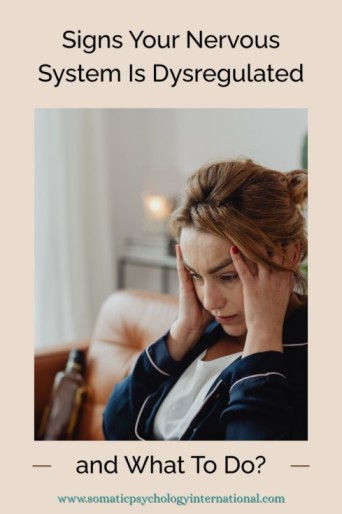
Signs Your Nervous System Is Dysregulated (and What to Do)

A few years ago, I was standing in the kitchen trying to decide whether to answer an email.
That was it. One email. Nothing urgent, nothing particularly difficult. But my body was behaving as though I had been asked to defuse a bomb. My jaw was tight. There was heat moving up my neck. I kept opening the laptop, then walking away from it again. At one point I found myself reaching for a sweet snack, which is apparently one of my nervous system’s preferred avoidance strategies.
The strange thing was that, externally, life looked fairly functional. I was working. Paying bills. Replying to messages eventually. I could still sound competent in conversations. Many people with dysregulated nervous systems can. Sometimes that is part of the problem. You become very skilled at appearing fine while your body quietly runs itself into the ground underneath you.
When people hear the phrase ‘nervous system dysregulation’, they often imagine something visible and obvious. Panic attacks in supermarket aisles. Big emotional reactions. Complete collapse.
Sometimes it looks like that.
Often it looks like answering emails with a tight chest and then wondering why you are exhausted all the time.
The nervous system is essentially your body’s way of tracking safety and threat. It is constantly taking in information from your environment, your relationships, your workload, your history, your own thoughts. When the system feels safe enough, there is flexibility. You can respond to life rather than constantly brace against it.
When the system gets overloaded for too long, that flexibility narrows.
You might notice yourself becoming reactive in ways that feel disproportionate. A small change of plans and suddenly your stomach drops. Someone takes too long to reply to a message and your whole body starts filling in catastrophic endings. Or you find yourself unable to rest properly, even when you finally have time.
I have clients who feel completely exhausted and utterly unable to sleep. Their body was tired. Their mind was tired. But there was a restless, electric feeling in their body, as though some internal motor was still running.
They get up around midnight and started doing some menial task.
Very productive. Very sane behaviour at midnight.
That is the thing about dysregulation. It does not always arrive as chaos. Sometimes it arrives as compulsive competence. Over-functioning. Constant doing. The inability to stop moving because stillness would mean finally feeling how overwhelmed you actually are.
Other signs are quieter.
You feel strangely flat around things you used to enjoy. Your attention scatters easily. You reach for your phone automatically every few minutes without even realising you are doing it. Conversations become harder to stay present in because part of your system is always somewhere else, scanning ahead.
The body usually tells the story long before the mind catches up.
A buzzing in the hands. Tightness below the sternum. Shallow breathing. Digestive issues that seem to appear out of nowhere. A sense of never fully arriving in your own life, even when nothing is technically wrong.
Research around nervous system regulation and trauma increasingly points toward the body’s role in shaping emotional wellbeing, not just reflecting it. Stephen Porges’ Polyvagal Theory describes how the autonomic nervous system constantly evaluates cues of safety and danger beneath conscious awareness. Many of the behaviours people criticise themselves for are actually adaptive physiological responses from a body trying to protect itself.
Which, frankly, can be both comforting and mildly annoying.
Because once you realise your nervous system is involved, you can no longer solve everything purely through thinking harder.
Many of us were trained to override bodily signals early. Push through tiredness. Ignore discomfort. Stay pleasant. Stay productive. Keep going. Then later we wonder why the body eventually begins communicating in increasingly loud and inconvenient ways.
Mine certainly did.
After becoming seriously ill in my twenties, I started recognising how disconnected I had been from my own physical experience for years. I could interpret other people’s needs beautifully. I could work in high-pressure environments across Kenya and India. I could hold enormous amounts emotionally for other people.
I could not tell when I needed to rest until my body forced the issue completely.
That level of disconnection does not repair itself through insight alone. The nervous system changes through experience. Through repeated moments where the body learns it no longer has to stay in constant defence.
Which means the first step is often smaller and less glamorous than people expect.
You begin by noticing.
Not analysing yourself. Not diagnosing every mood. Just noticing.
What happens in your body when your phone lights up with a message from a particular person? What happens to your breathing when you sit down to rest? Can you feel your feet on the floor right now, or has your attention already floated three hours into the future?
Tiny moments of awareness begin rebuilding connection.
Then comes something equally important: reducing the amount of input your system is trying to process all day. Most nervous systems I see are not failing because people are weak. They are overloaded. Too much noise. Too much information. Too little actual recovery.
Sometimes regulation looks less like adding another wellness practice and more like sitting outside for ten minutes without consuming anything at all.
No podcast. No scrolling. No self-improvement audiobook explaining how to optimise your morning routine while your nervous system quietly begs for a nap.
Just you, your body, and a small amount of stillness.
The body responds surprisingly quickly to genuine moments of safety. Not perfect safety. Just enough. Enough for your shoulders to drop half an inch. Enough for your breath to deepen without force. Enough for your system to realise it does not have to grip so tightly right now.
If you want somewhere to begin, start there.
Notice what your body does in the next hour when nothing is demanding your attention.
And then see if you can stay with yourself long enough to hear what it has been trying to say.
References
Porges, S. W. (2011). The Polyvagal Theory: Neurophysiological Foundations of Emotions, Attachment, Communication, and Self-Regulation. W. W. Norton & Company.
van der Kolk, B. (2014). The Body Keeps the Score: Brain, Mind, and Body in the Healing of Trauma. Viking.
Liked It? Pin It!




Comments